

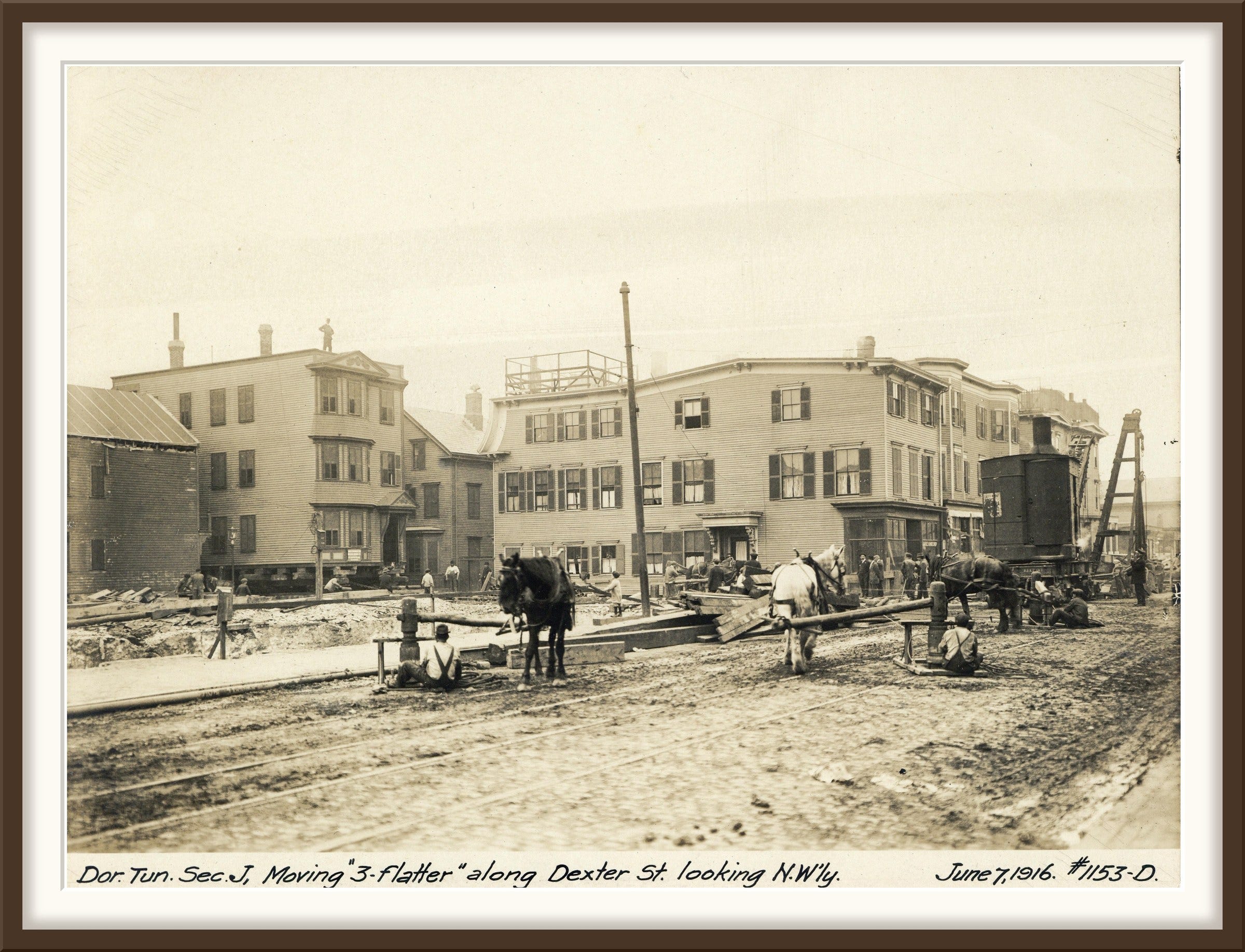
Last week I left you with a photograph of a house going down Central Street in Woodstock in 1909 and asked you to count the animals pulling it. There was one. The picture above is Boston, seven years later, and there are four at work in it. Look again, though, because they are not four horses on one rope. They are four separate rigs, one horse apiece, set up to walk a three-decker out of the path of a subway tunnel. Three are planted out in Dorchester Avenue, heads down, rope in loose coils, the men at the drums sitting in the dirt. The fourth stands in Dexter Street by a carved doorway, a man at its head, and it is the only one whose legs you cannot see. This is how any of that is possible, and it is not a story about a strong horse.
The answer is that the horse is not pulling the house. It is walking in a circle and turning a machine, and the machine pulls the house. For those who want the arithmetic that proves it, and the whole rig stage by stage, it is on a page of its own.
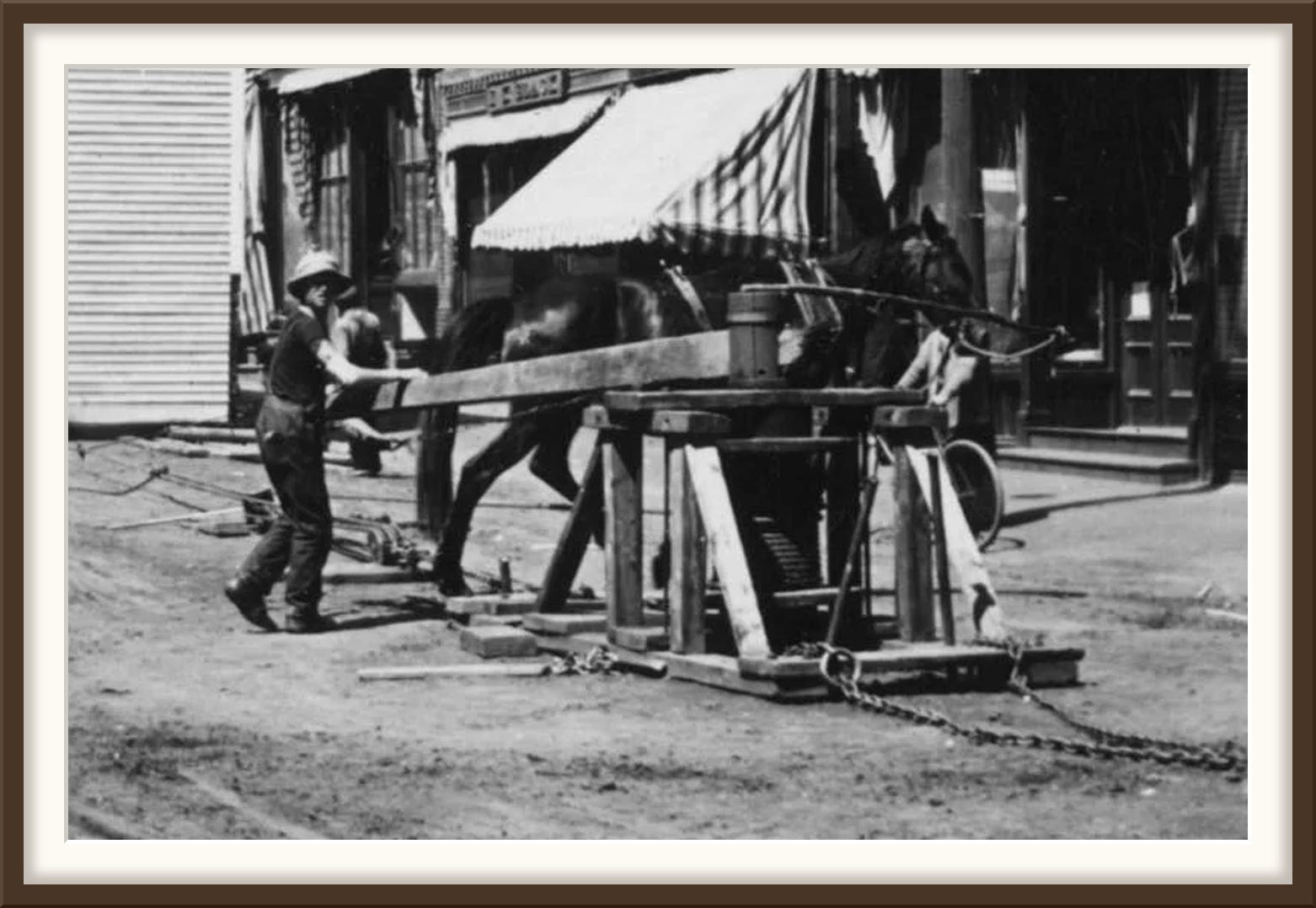
Look at the Woodstock picture again and you will see the horse is not facing the house. It does not need to be. It is walking a circle, so its heading changes with every step, and it comes round to face the house once a lap, the same as it faces everything else on that circle. Only the drum cares which way it points.
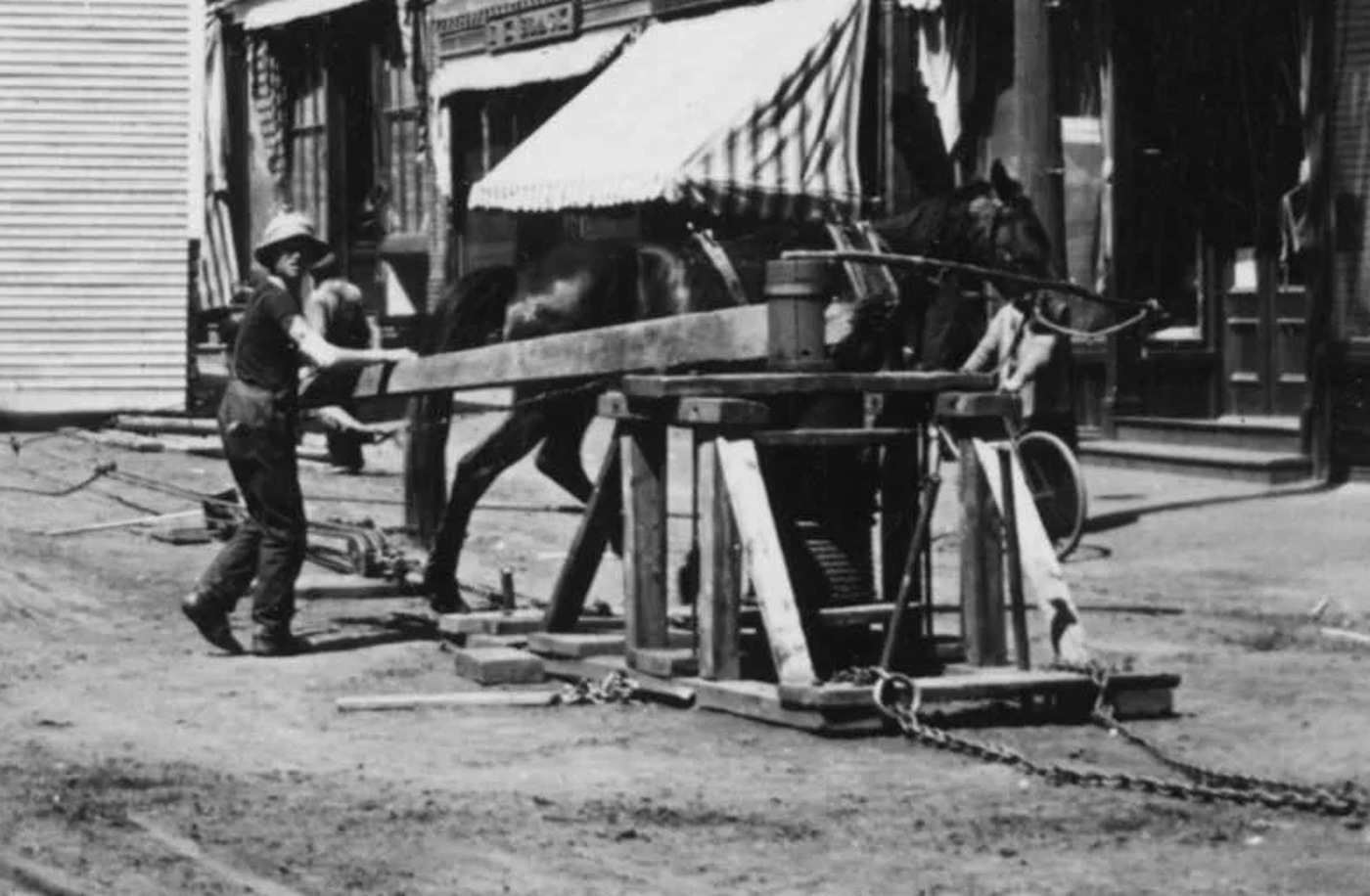
Look once more at the drum itself, because the picture is telling you something about time. There is something like a hundred and fifty feet of rope wound on that barrel, and run out to the anchor and back through the block on the house, the building creeps forward only half as far as the rope winds in. Seventy-five feet, then. Which is to say the house has very nearly reached the capstan, and everything is about to stop while the crew drags the capstan, its anchor and the whole rig further up the street, sets it all again, and starts over.
Here is the part that surprised me. Those seventy-five feet are about ten minutes of turning the drum, at the pace Knight's gives for a horse on a sweep. They are not ten continuous minutes. The pull halts over and over while men carry the rollers from the back round to the front and shift the plank track ahead, and at the end of the run the anchor comes up, the capstan is dragged forward and planted again, and the line is re-rove before the horse walks at all.
That is the real reason a move was measured in feet per day. Not because the horse was slow.
Look back at the photograph at the top one last time, because it puts the whole question in a single frame. The dark machine on the right is a steam hoisting engine on its own car, boiler and stack and all, with "Keep Off" lettered on its side, and the timber A-frame beside it is a pile driver. Neither one digs. The hoist swings the spoil up out of the trench and lowers the steel and the timbering back down into it, and the pile driver drives the sheeting that holds the walls apart. The digging belongs to another machine entirely.
So there is a steam engine in this photograph with steam up, twenty feet from the house, and the house is going by horse.
Coming up
Keep an eye on your feed. Three rabbit holes run out of this one photograph, and I intend to go down all three.
Last week, if you missed it

More Upper Valley


A word of thanks
To the City of Boston Archives, who keep the Transit Department’s photographs of this work and put them online at a size worth zooming into. Five plates of Dexter Street survive, taken between the twentieth of May and the twenty-eighth of June 1916, and the one at the top of this post is only one of them.
Full-resolution images
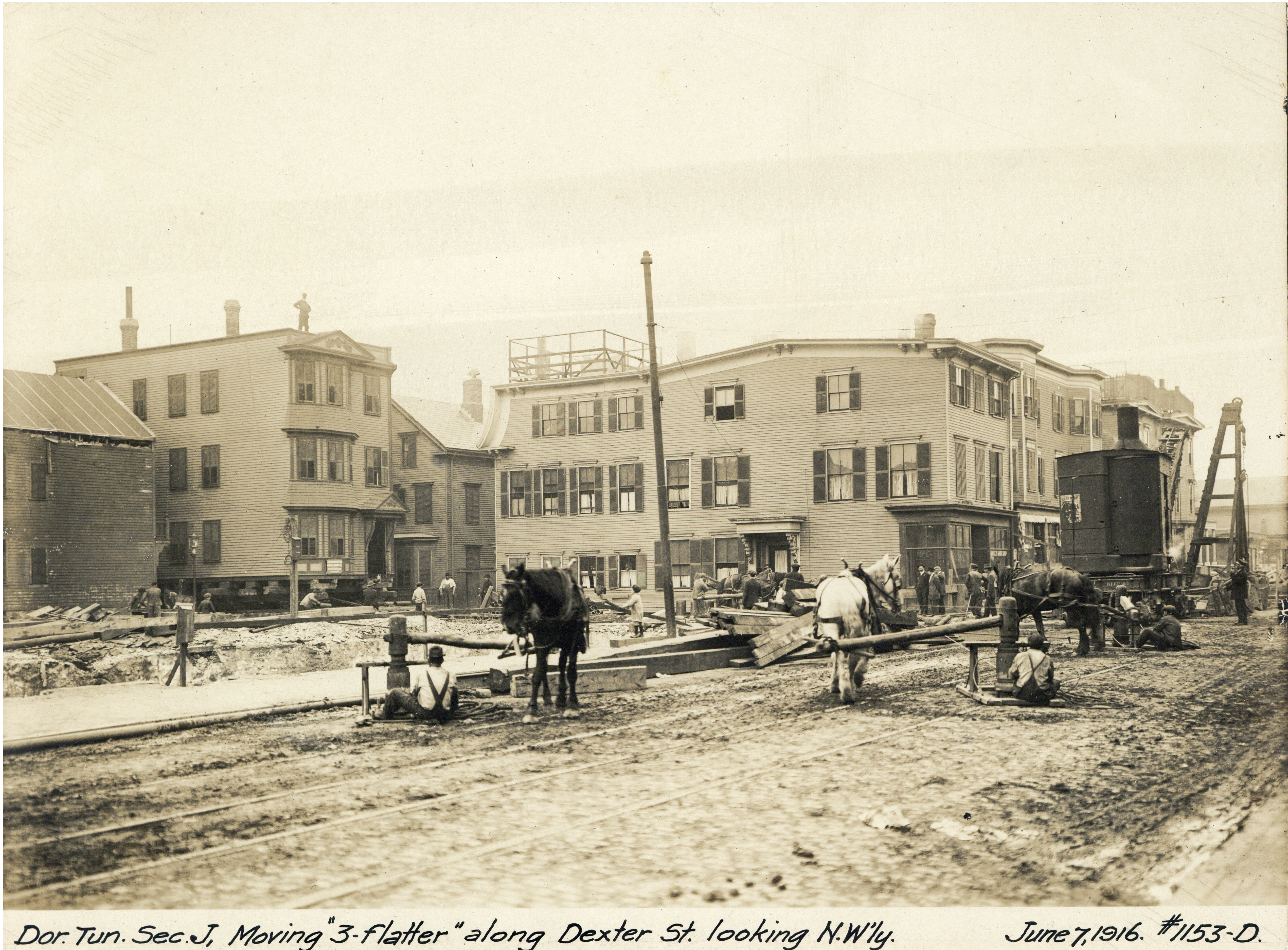
Dexter Street, Boston, 1916, at full size, five thousand pixels wide
The capstan, close up, for counting the turns of rope
Thanks for your support, as always,
Cameron Cross
Sources
The Woodstock photograph: the Dr. Mack house being moved along Central Street, Woodstock, July 1909, Woodstock History Center collection, archive item 0681, reproduced by courtesy of the Woodstock History Center.
The Boston photograph: Dexter Street, 7 June 1916, negative 1153-D, Transit Department photographs, Collection 8300.002, City of Boston Archives, Creative Commons BY 2.0. By way of the archives' own Flickr, which is worth an evening.
The tunnel: the negative's own caption reads “Dorchester tunnel section J.” The Dorchester Tunnel carried the Cambridge subway south, and it is the Red Line today. It reached Broadway in December 1917 and Andrew, at the end of Dexter Street, in June 1918.
The method: Knight’s American Mechanical Dictionary, 1876, page 1138, plus the longer version of all of this, step by step, with what a move cost and how slowly it went.
This post is amazing - great research. I'm ready to go down the rabbit holes with you, Cam.