

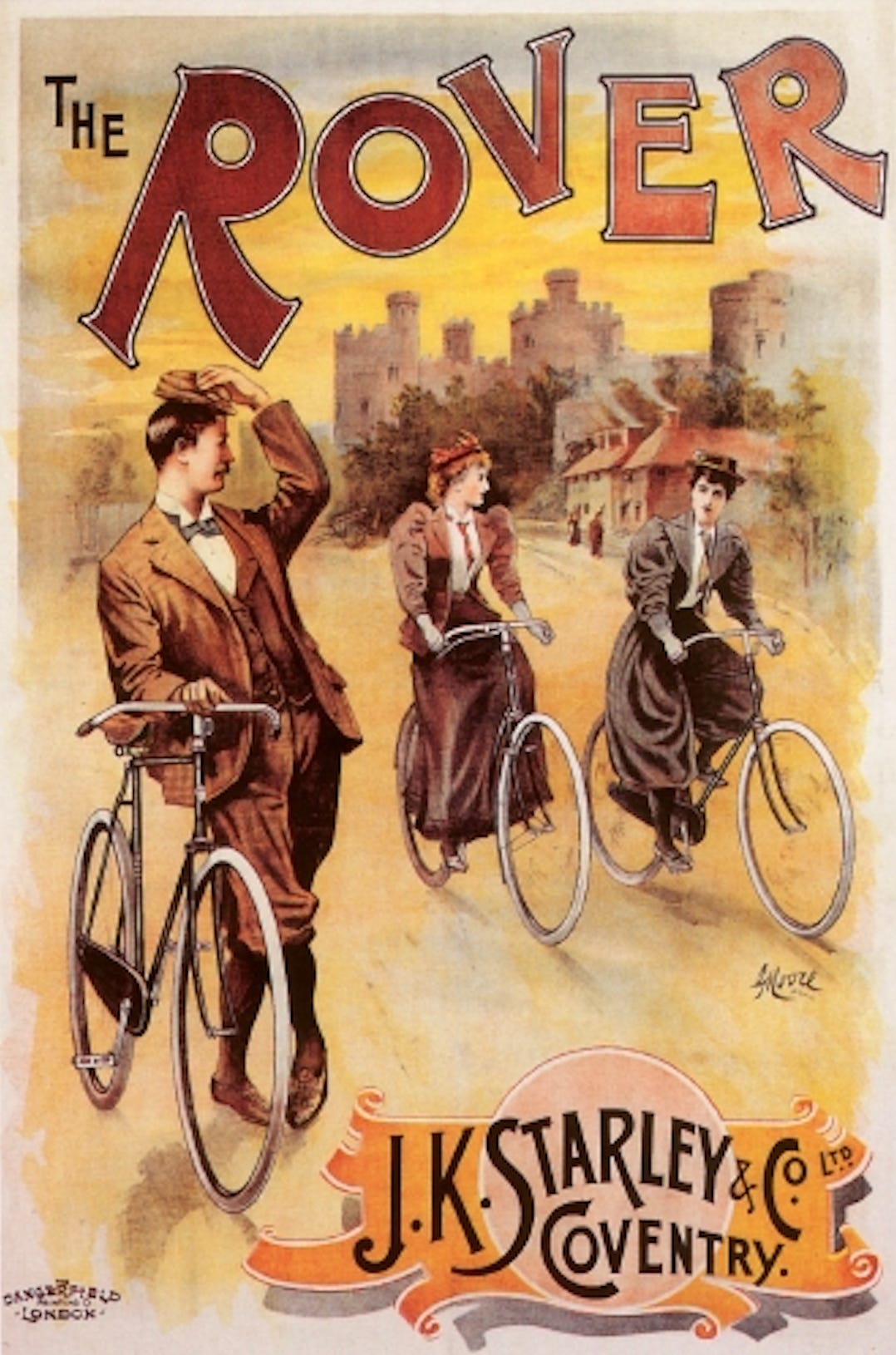
Jigsaw for May 10, 2026: The Rover
It’s the time of year when we’re seeing bicycles everywhere as cyclists are eager to be back in the saddle after being sidelined during the ice and snow.
I was curious as to how the bicycle has evolved since its beginnings, and was delightfully fascinated by what I found.
The term “Penny Farthing” came from the British coins of the era: the penny was very large and the farthing very small. However, this is more of a modern term. During their heyday they were known simply as “Bicycles.”
I started here:
https://en.wikipedia.org/wiki/Penny-farthing
http://www.barthaynes.com/the-history-of-the-penny-farthing/
During this time, penny-farthings, also known as ordinaries or high wheelers today, were only for the upper middle class and high society. Many bike clubs in Britain were extremely picky when it came to who they admitted. All members of leagues needed an official recommendation from a current member and a costly uniform.
In 1878, Albert Pope began to manufacture the Columbia bicycle and did so successfully for two decades in America. After this, the penny-farthing trend died down and gave way to John Kemp Starley’s Rover Safety Bicycle of 1885 (see puzzle) that more closely resembles the modern bicycle.
The penny-farthings are now a symbol of the Victorian era and a milestone in the launching of cycling as a sport. They are intriguing, and I hope to ride one someday.
Or not.
I have a feeling I might have a similar experience as Mark Twain had:
“When you have reached the point in bicycling where you can balance the machine tolerably fairly and propel it and steer it, then comes your next task — how to mount it. You do it in this way: you hop along behind it on your right foot, resting the other on the mounting-peg, and grasping the tiller with your hands. At the word, you rise on the peg, stiffen your left leg, hang your other one around in the air in a general and indefinite way, lean your stomach against the rear of the saddle, and then fall off, maybe on one side, maybe on the other; but you fall off. You get up and do it again; and once more; and then several times.
By this time you have learned to keep your balance; and also to steer without wrenching the tiller out by the roots (I say tiller because it is a tiller; “handle-bar” is a lamely descriptive phrase). So you steer along, straight ahead, a little while, then you rise forward, with a steady strain, bringing your right leg, and then your body, into the saddle, catch your breath, fetch a violent hitch this way and then that, and down you go again.”
Some local photos:


Also of interest:
Pictures of an Aroostook County man’s homemade one
https://en.wikipedia.org/wiki/Velocipede
https://roadswerenotbuiltforcars.com/jkstarley/
https://www.express.co.uk/life-style/top10facts/855278/Ten-facts-Penny-Farthings-supper-club-event-London-high-wheel-bicycle
Early penny-farthing riders in American were known as “Wheelmen”.
Nearly seventy car makers began as bicycle manufacturers: Rolls-Royce, Aston Martin, Chevrolet, Cadillac and GMC, to name a few.
The world record for distance ridden in an hour on a penny-farthing is 23.72 miles set in 1891.
Thomas Stevens was the first person to cycle across the United States on a penny-farthing, completing the journey from San Francisco to Boston in 1884. Whew!
Thanks for reading, as always.
Support your local historians!
Cameron Cross
for the
Norwich Historical Society