

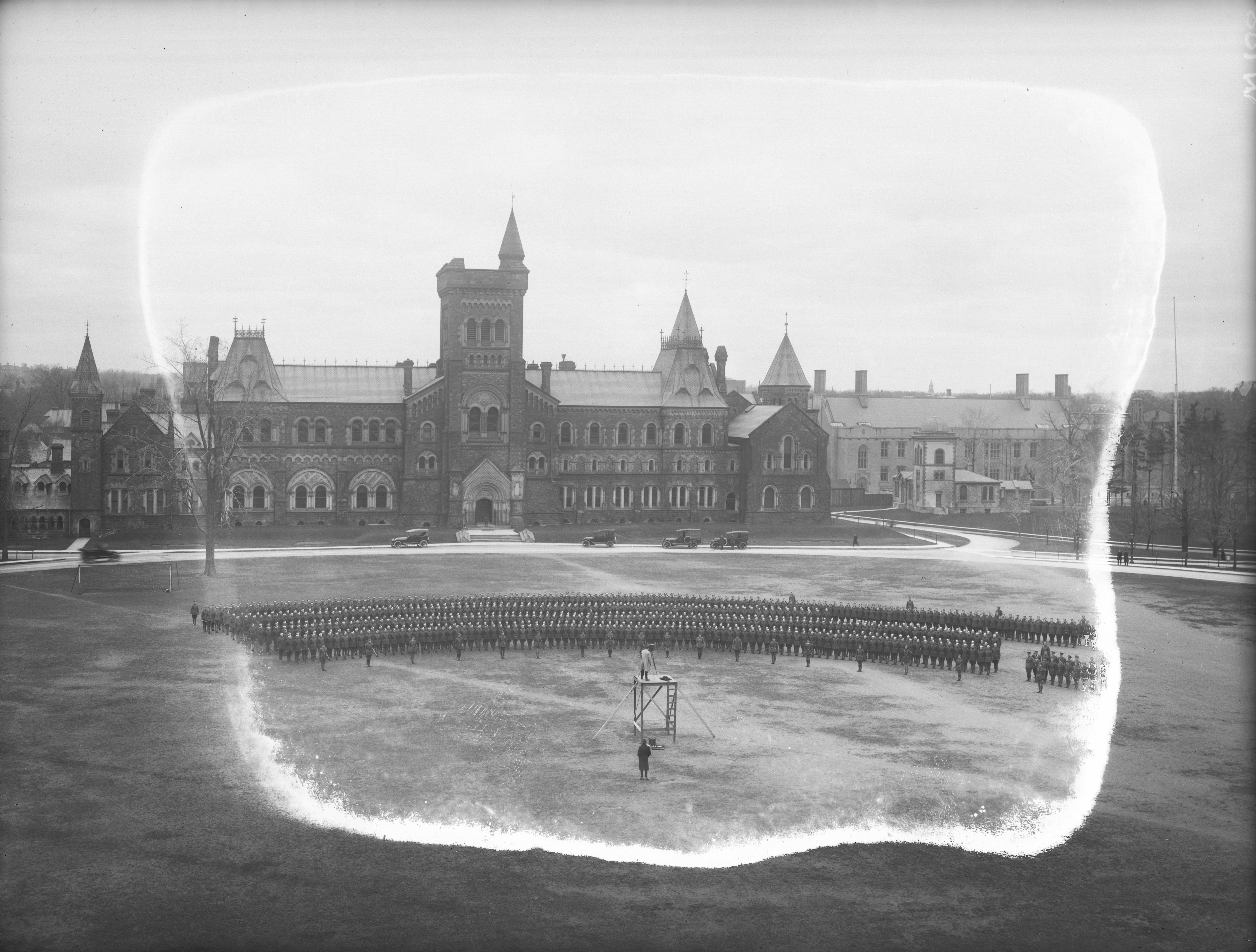
You may have already seen a Cirkut panorama without knowing it. The cabinet-sized device that produced this whole genre — group portraits like the one above, sweeping views of railroad yards, even hundreds of soldiers in a single frame — was patented in 1904 by William J. Johnston and built by the Folmer and Schwing division of Eastman Kodak. The halo is an artifact from the original scanning. The original print had no halo. And no, it’s not a wormhole into the space/time continuum.
Here's what one looked like:
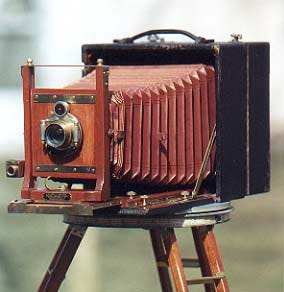
A clockwork motor rotated the whole camera on its tripod. A slit at the back of the lens housing exposed a vertical column of film at a time, while a reel of long, paper-backed film fed past the slit, synchronized with the rotation. One squeeze of the bulb committed you to the entire sweep. You could not stop mid-arc.
The film came out in inches, not millimeters. Five, six and a half, eight, ten, even sixteen inches wide. The Library of Congress holds a 1906 Cirkut of Washington that runs twenty feet.
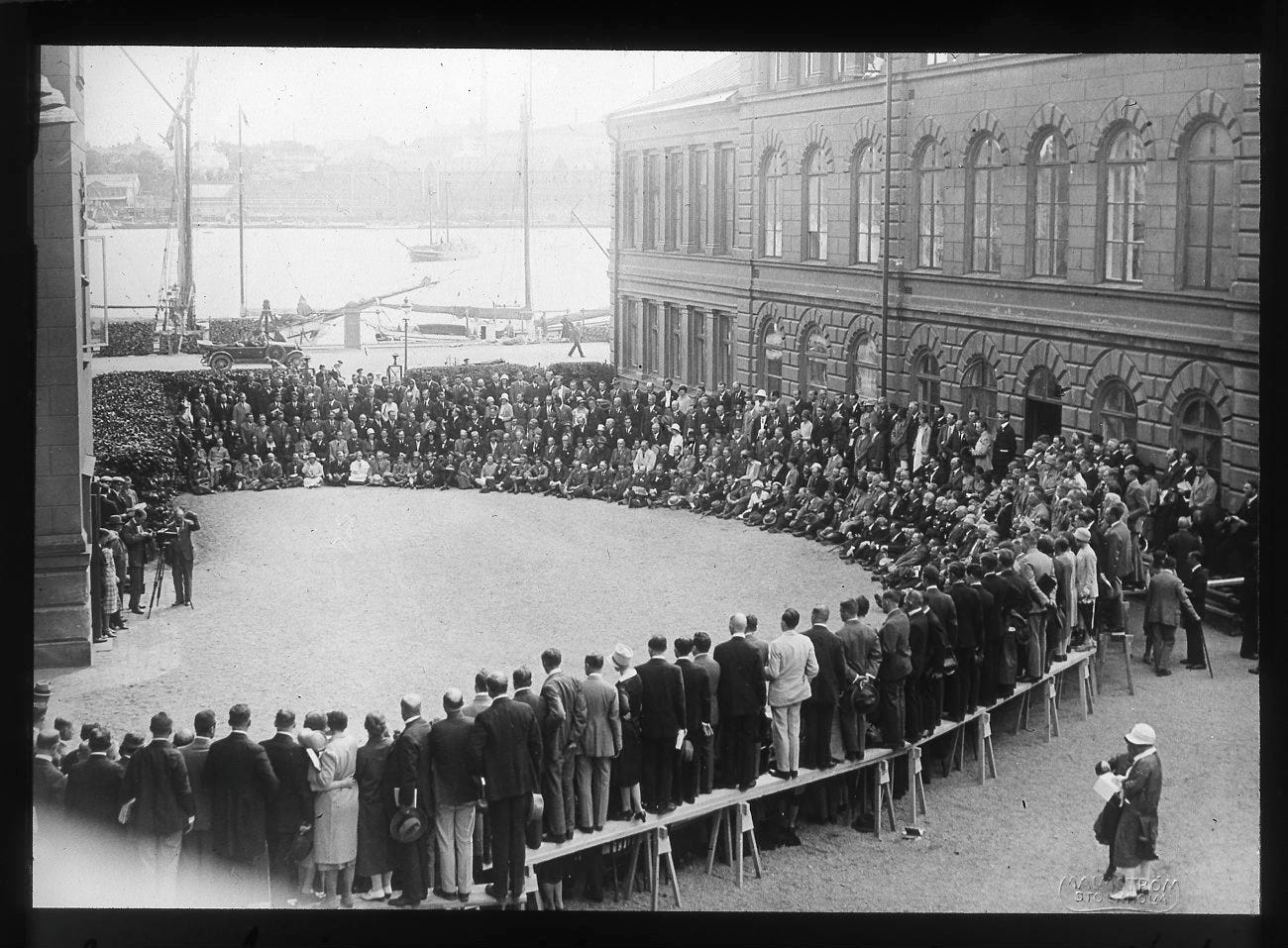
The Cirkut survived in commercial use into the 1940s. You can still see a working one occasionally, like in this 1950 setup in Stockholm:
The format had quirks. A person who moved during the sweep smeared. The classic trick was for the assistant to walk along behind the rotation, so they appeared at both ends of a group portrait. And if the sun was on one side of the arc, that side blew out the exposure. The Cirkut did not edit. It recorded the long, awkward, beautiful truth of what it saw.
The Cirkut took countless famous American panoramas — class photos, military reviews, baseball teams, town views. One example of that work is in this week's puzzle: a panorama of White River Junction, August 1915, photographed by a Brooklyn man named Henry Barreuther.
For the full rabbit hole: Cirkut on Wikipedia (en.wikipedia.org/wiki/Cirkut_(camera)), and the enthusiast site at cirkut.org.
Cameron Cross
for the
Norwich Historical Society