

Jigsaw for September 26, 2026: Lake Street, Chicago
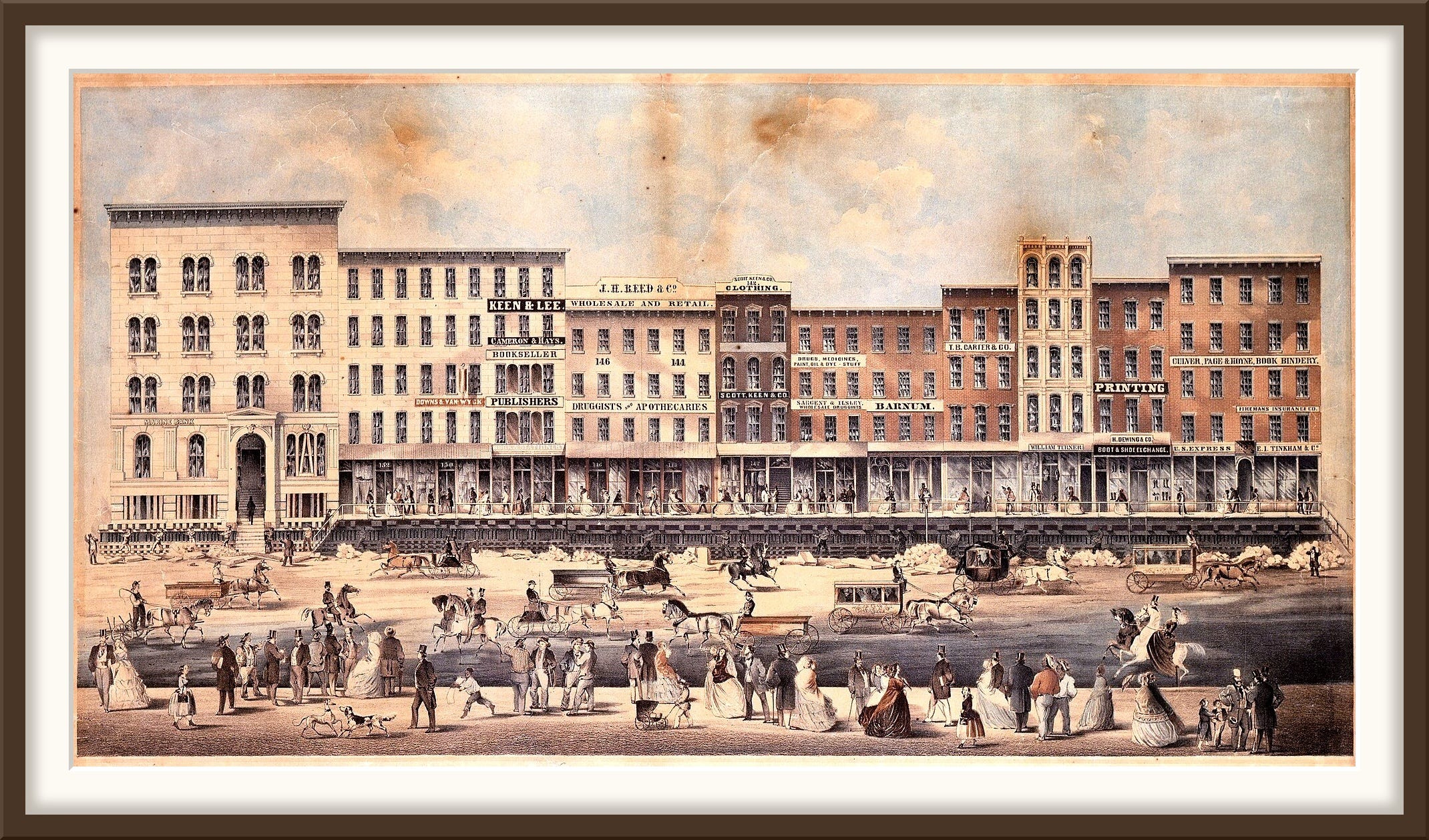
One last post about moving buildings. It starts in Chicago, and it ends on familiar ground for many of us.
Nine in one day
Moving a building sounds like a once-in-a-lifetime event. In the nineteenth century it was ordinary. David Macrae, a Scottish minister, came into Chicago by train in 1869, and the first thing he saw on the drive to his hotel was a house coming up the street toward him. He pointed it out to the driver in amazement.
“Did you never see a house moving before?” said he unconcernedly. “No. Do your houses move about like that?” “Wall,” he said, “there’s always some of them on the move.”
The driver was right. “Never a day passed during my stay in the city that I did not meet one or more houses shifting their quarters. One day I met nine.” Twice his horsecar had to stop and let houses get across Madison Street. People sat at the windows as they went by. One was a double shop, cigars at one end and confectionery at the other, and the shopkeeper stood leaning against the door-post smoking a cigar while his store traveled.
Whole blocks at a time
And it was not only houses. Chicago was built on ground too flat to drain, and it spent years jacking itself up out of the mud: office buildings, hotels, whole blocks at a time. In 1860 a 320-foot row of four- and five-story brick shops and offices on Lake Street went up four feet eight inches on six thousand screws, turned by six hundred men, in five days, with the stores open and the customers walking in and out the whole time. That is the picture at the top of this post.
Strictly speaking, that is a move too. The screwjacks just moved the building in the one direction nobody thinks of: straight up. The year after, five hundred men lifted the six-story Tremont House hotel six feet the same way, with the guests still in their rooms.
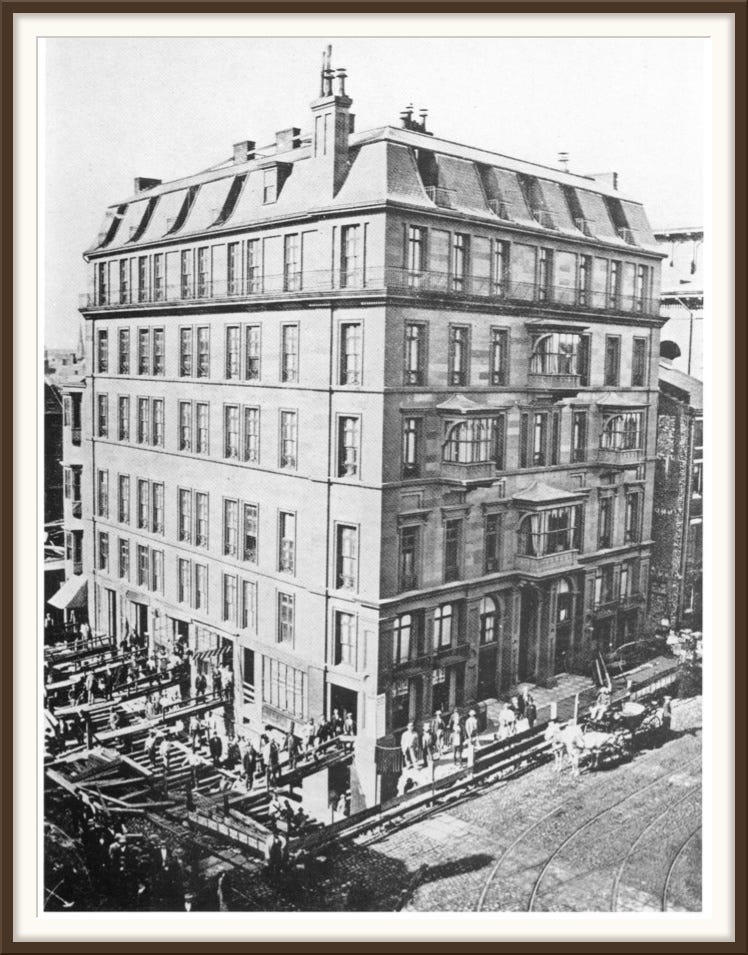
Boston did it sideways. In 1869 the city widened Tremont Street and would not pull down the seven-story Hotel Pelham to do it, so the whole brick building was slid about fourteen feet across its own lot. It took three months, and nobody moved out.
The church that walked
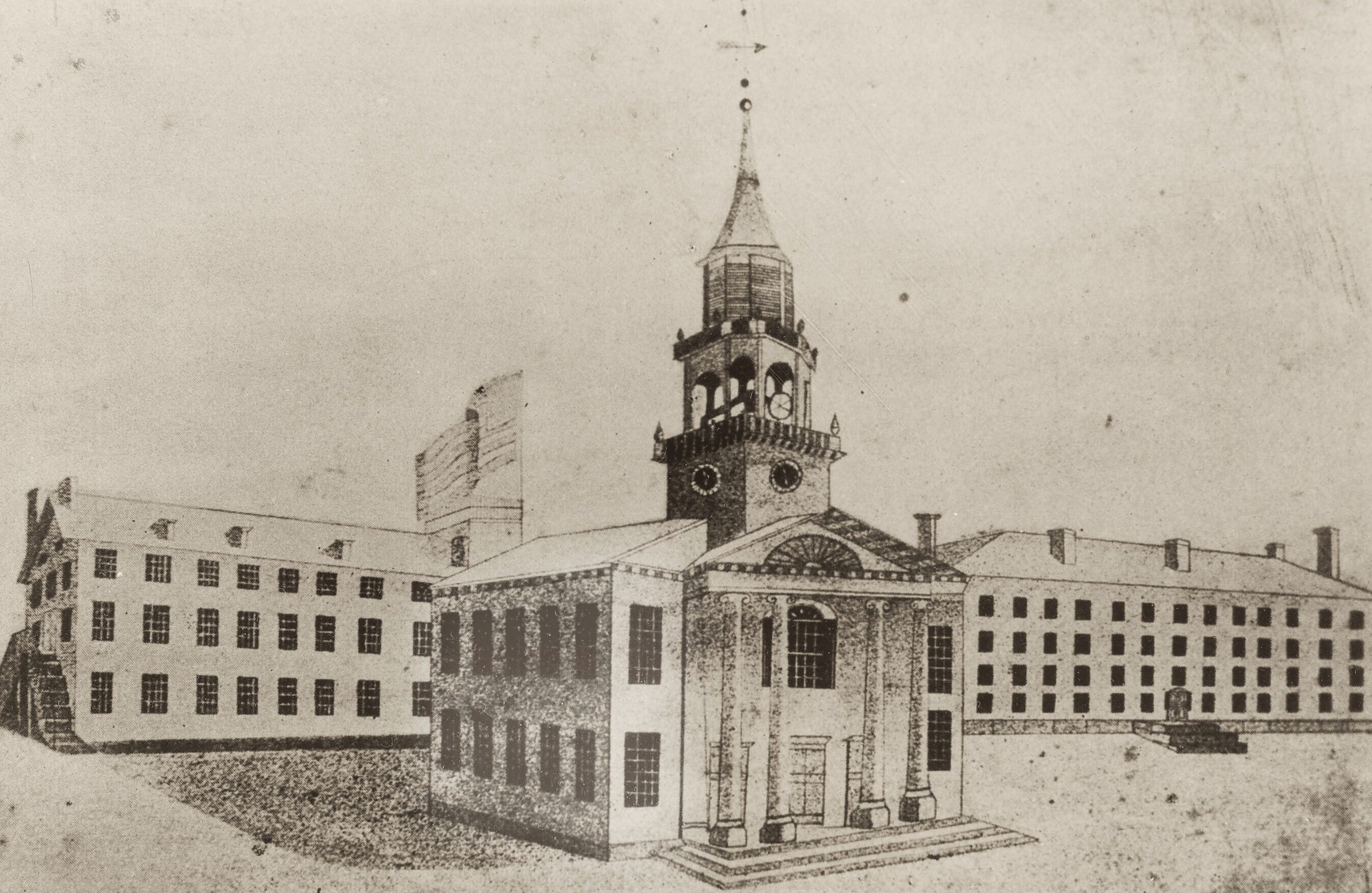
Now the one close to home. The Congregational church went up on the Norwich green in 1817, when Norwich town center started moving to the grounds of what was then called ??????> The south end won. Then in 1852 the congregation picked the church up, moved it a few hundred feet to where it stands today, and turned it to face south instead of west. While they had it in the air, they made it one bay longer.
Nobody wrote down how. Photography had barely reached Vermont, so what survives of the green as it was is this drawing. Count the windows down the side of the church: five. Today there are six.
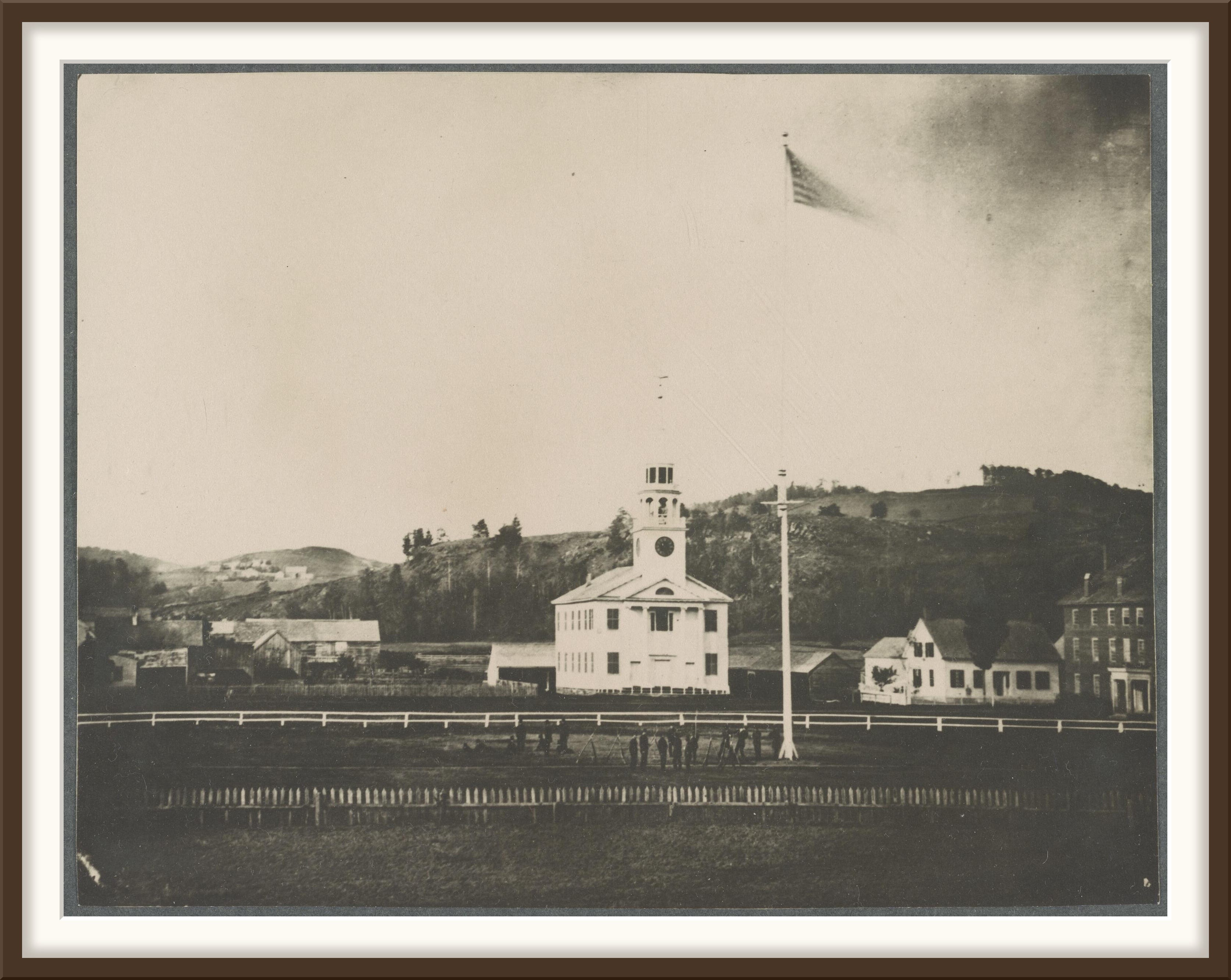
By the 1860s somebody had brought a camera. This is from out on the parade ground, cadets drawn up by the flagpole, and that is the same church, portico and clock tower, sitting where the move left it and where it still stands. Note the now-hidden views to Willey Hill Road, and to what became the Pierce and Van Arman farm on Union Village Road. And the white fence went between the two academy buildings rather than directly next to Church Street.
That had changed by the time of the picture below.
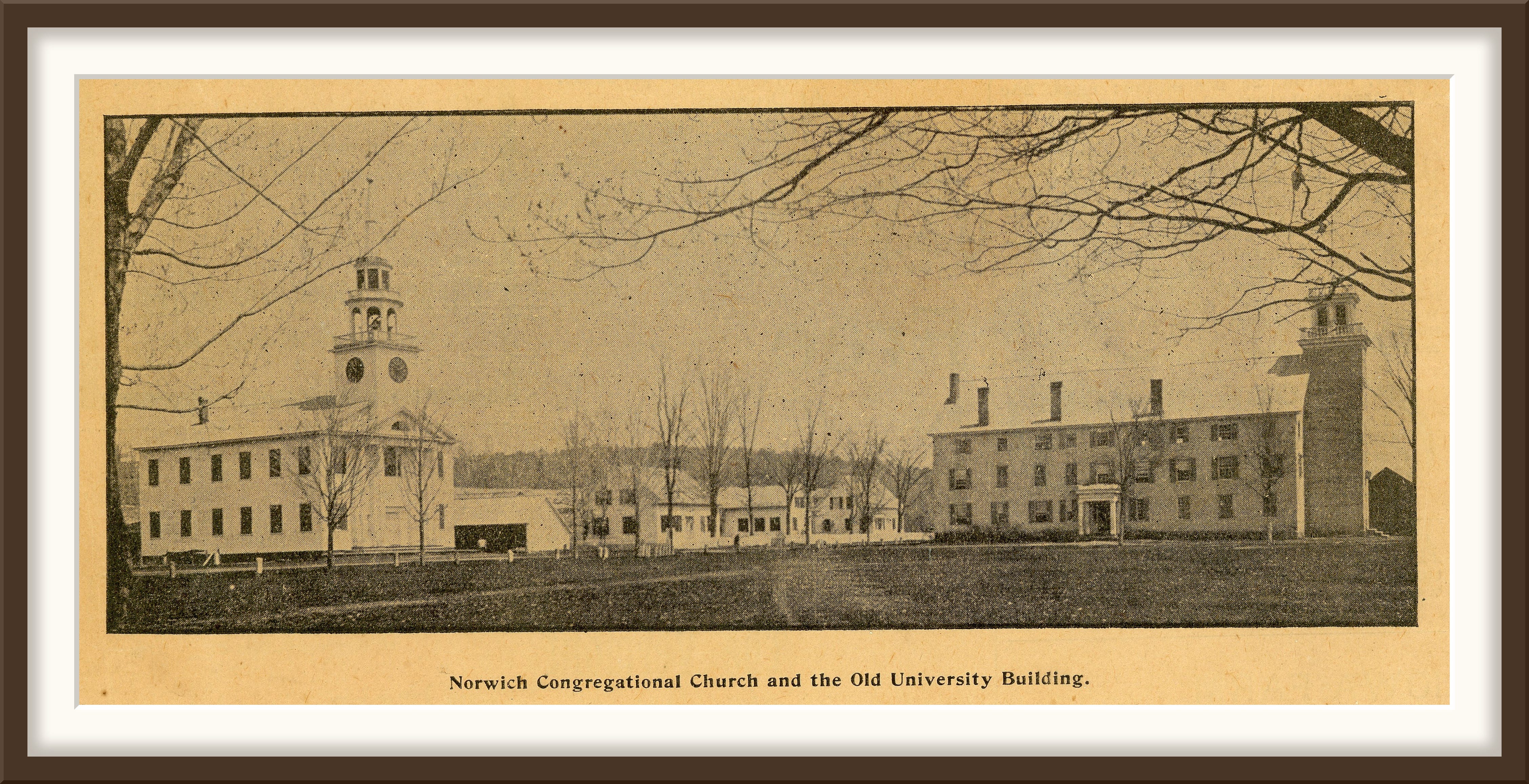
Once you know that buildings walked, the Upper Valley reads differently. A Greek Revival house facing the wrong way. A hotel with mismatched halves. A church a few hundred feet from where it was built, facing south. Some of it is not odd at all. Some of it just moved.
And that is the end of the moving buildings. Next we stay on the Norwich green, because the barracks standing behind the church in that drawing never got to walk anywhere. On a March night in 1866 South Barracks burned to its chimneys, and before the year was out Norwich University had left town for Northfield. So in the end the building stayed put, and it was the university that moved. That is where we pick up.
If you want to see one go: in 2016 the Old Stone House Museum in Brownington, Vermont, brought its 1823 schoolhouse home behind forty-four oxen, with some help from a motorized carriage. Here is the video.
Earlier in this series


More Upper Valley

A word of thanks
To Rauner Special Collections at Dartmouth, whose photographic files hold both the drawing and the 1860s view, and to the Norwich Historical Society, who keep the church’s own picture and have said plainly in print that very little was ever written about this move. They are right, and it makes the drawing all the more valuable.
Thanks for your support, as always,
Cameron Cross
Full-resolution images
The drawing of the green before 1852

The church in its new spot, 1860s

The church and North Barracks, about 1895


Sources
The drawing and the 1860s photograph: Dartmouth College Photographic Files, Rauner Special Collections Library, Dartmouth College, courtesy of Digital by Dartmouth Libraries. The same drawing appears as a plate facing page 111 of Goddard and Partridge, History of Norwich, Vermont, 1905. The view from about 1895: Norwich Historical Society, gift of Richard H. Cummings.
The church’s origins, the contest between Norwich Center and Norwich Plain, the distance it traveled and the bay added while it was in the air come from the Historic American Buildings Survey report, HABS VT-53. A note on the year: the 1905 town history says 1852 in its text and 1853 in a plate caption, and HABS says 1853. I have gone with 1852.
Lake Street: lithograph by Edward Mendel, Chicago Historical Society, public domain. The Hotel Pelham: Society for the Preservation of New England Antiquities, reproduced in Jean A. Follett, "The Hotel Pelham: A New Building Type for America," American Art Journal, 1983, public domain. The eyewitness: David Macrae, “The Americans at Home,” volume II, pages 190 to 192, 1870, public domain.
The Chicago figures are the ones the standard accounts of the raising of Chicago agree on. Accounts of the Pelham differ on the distance, from thirteen feet ten inches to thirty; the three months and the fact that it stayed occupied are consistent. The longer version of the method: the whole rig, stage by stage.