

Jigsaw for October 3, 2026: Fenway Park, 1912, and a second one: Fenway Park, 2026
I went to Fenway last week.
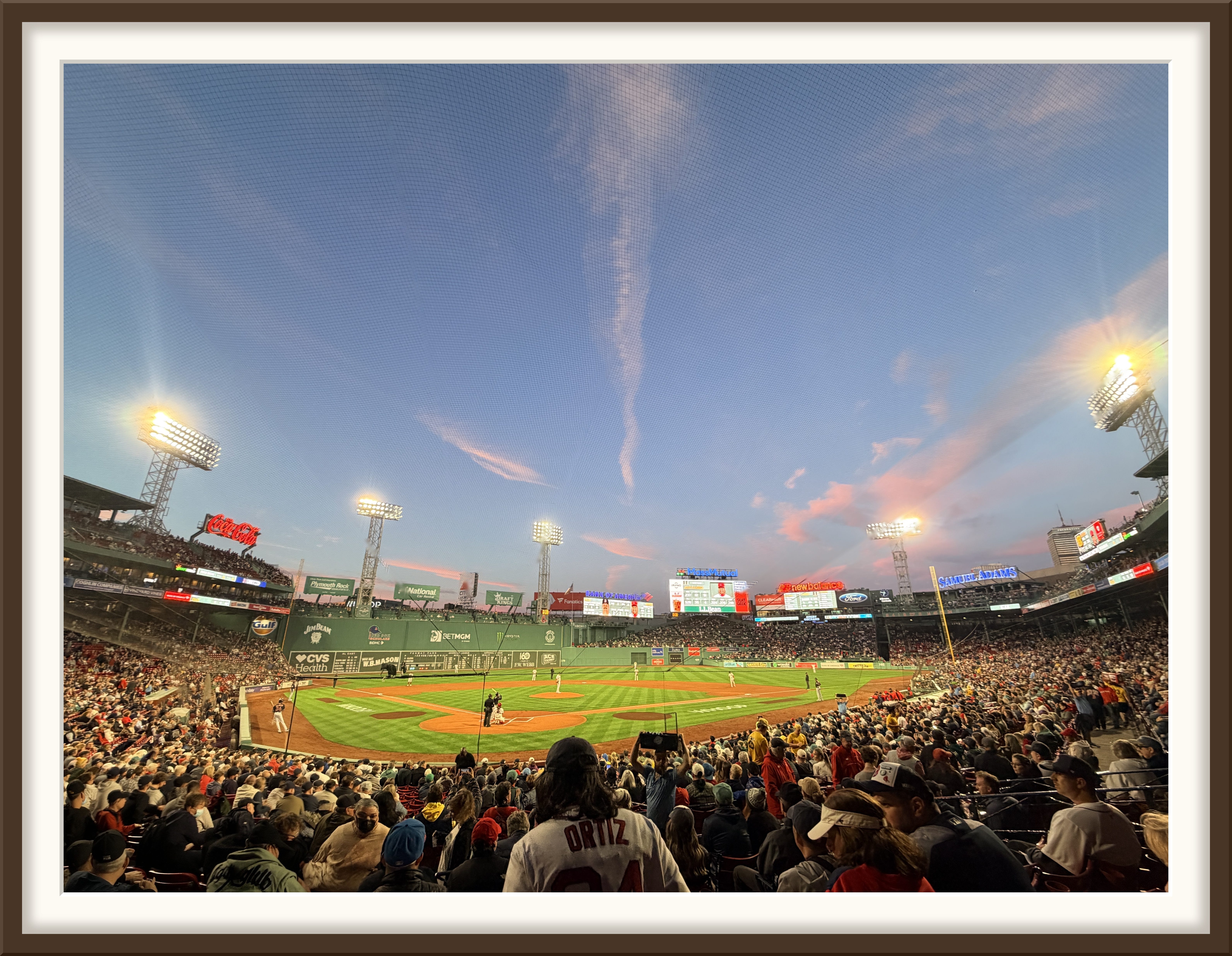
The Sox were listless and lost 3 to 2. No surprise there. Nice clouds, though. It reminded me how much I love Fenway Park.
I had hoped this would be a double celebration, with the Sox beating the Yankees in the wild card series. That didn’t work. To add insult to injury, one of the Yankees’ stars was Ben Rice, who grew up in Cohasset, Massachusetts, and played at Dartmouth. Still, this team deserves a lot of credit. After falling to 32-46, they went on a blistering 32-5 run.
But back to Fenway. I’ve going to games there since the mid-1970s. I remember sitting there between innings many just listening to the crowd talk. Now it’s all organ music, promotions, the kiss cam, ad not-quite-infinitum, including big ads for liquor and gambling on the Green Monster. You’d think being a long foul ball away from the Hotel Buckminster, where the “Black Sox” plan was hatched, would give them pause. So I went looking for how that wall evolved, and this post is the result.
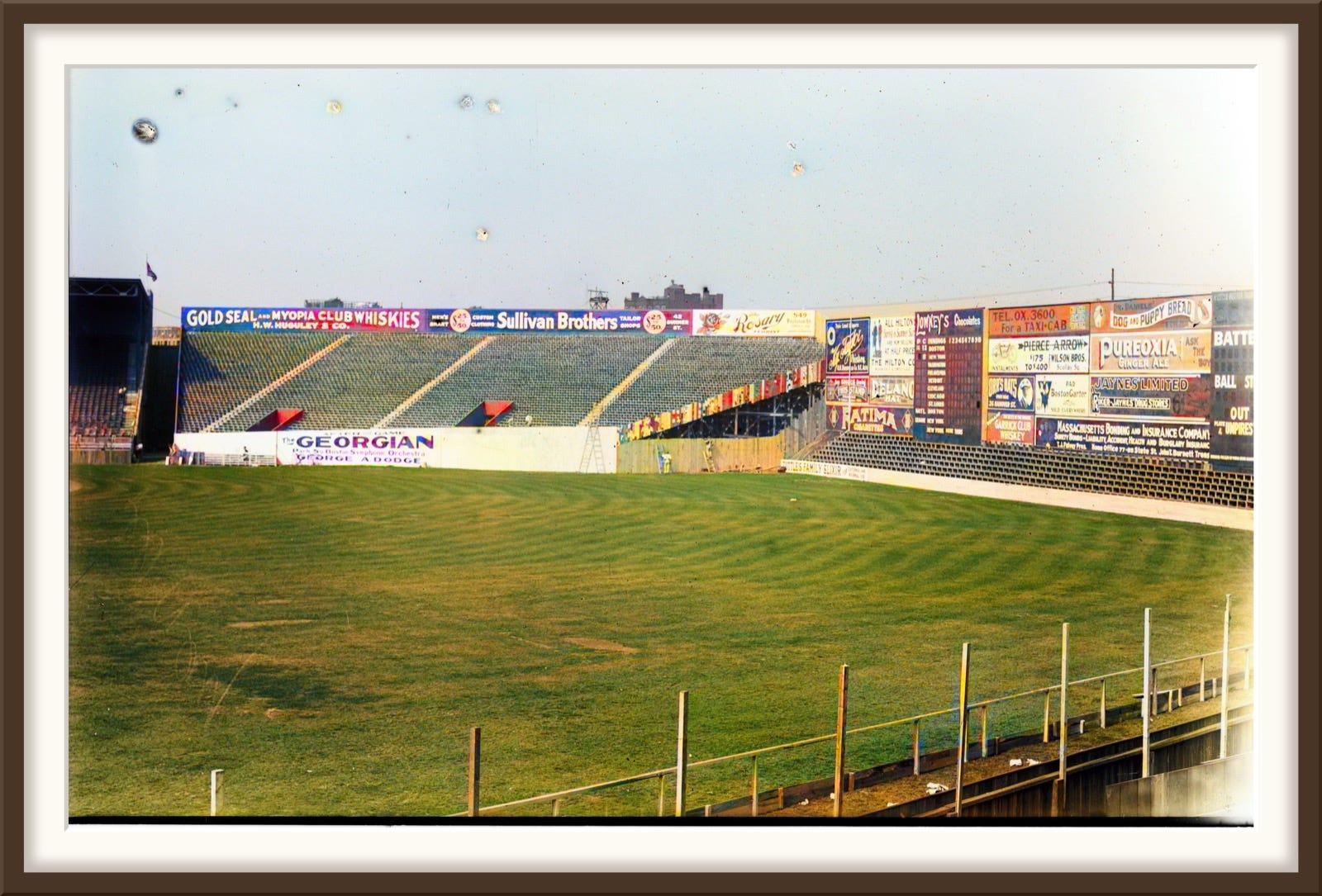
Our puzzle is the park five months after it opened, photographed from the grandstand on September 28, 1912. The wall is not green. It is a billboard, twenty-odd advertisers painted edge to edge: Fatima Cigarettes, Lowney’s Chocolates, Gold Seal and Myopia Club Whiskies, Pureoxia Ginger Ale, Dr. Daniels’ Dog and Puppy Bread. A few are still with us. Massachusetts Bonding and Insurance is today’s Hanover Insurance Group, and Dr. Daniels is still in business in Webster, Massachusetts. My favorite is down on the rail: Tuttle’s Family Elixir, “for external and internal use,” a racehorse leg wash bottled for people at 30 percent alcohol. You rubbed it on, or you drank it.
Before the ballpark
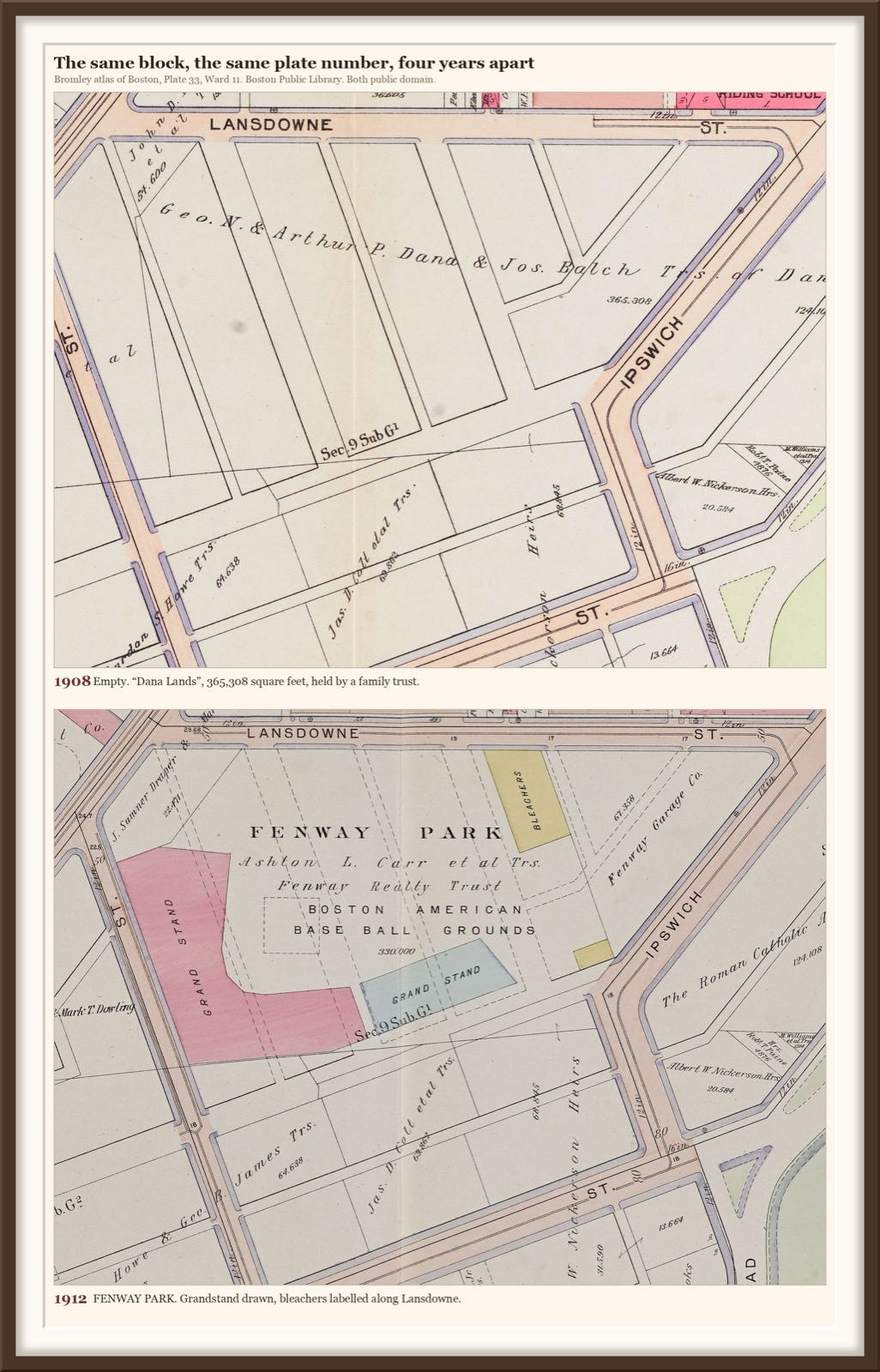
I expected a swamp, since Fenway sits beside the Fens. The 1908 Bromley atlas says otherwise: the block between Lansdowne and Ipswich Streets was dry, empty, filled land held by a family trust. Four years later the same plate reads FENWAY PARK, BOSTON AMERICAN BASE BALL GROUNDS.
The hill in left field
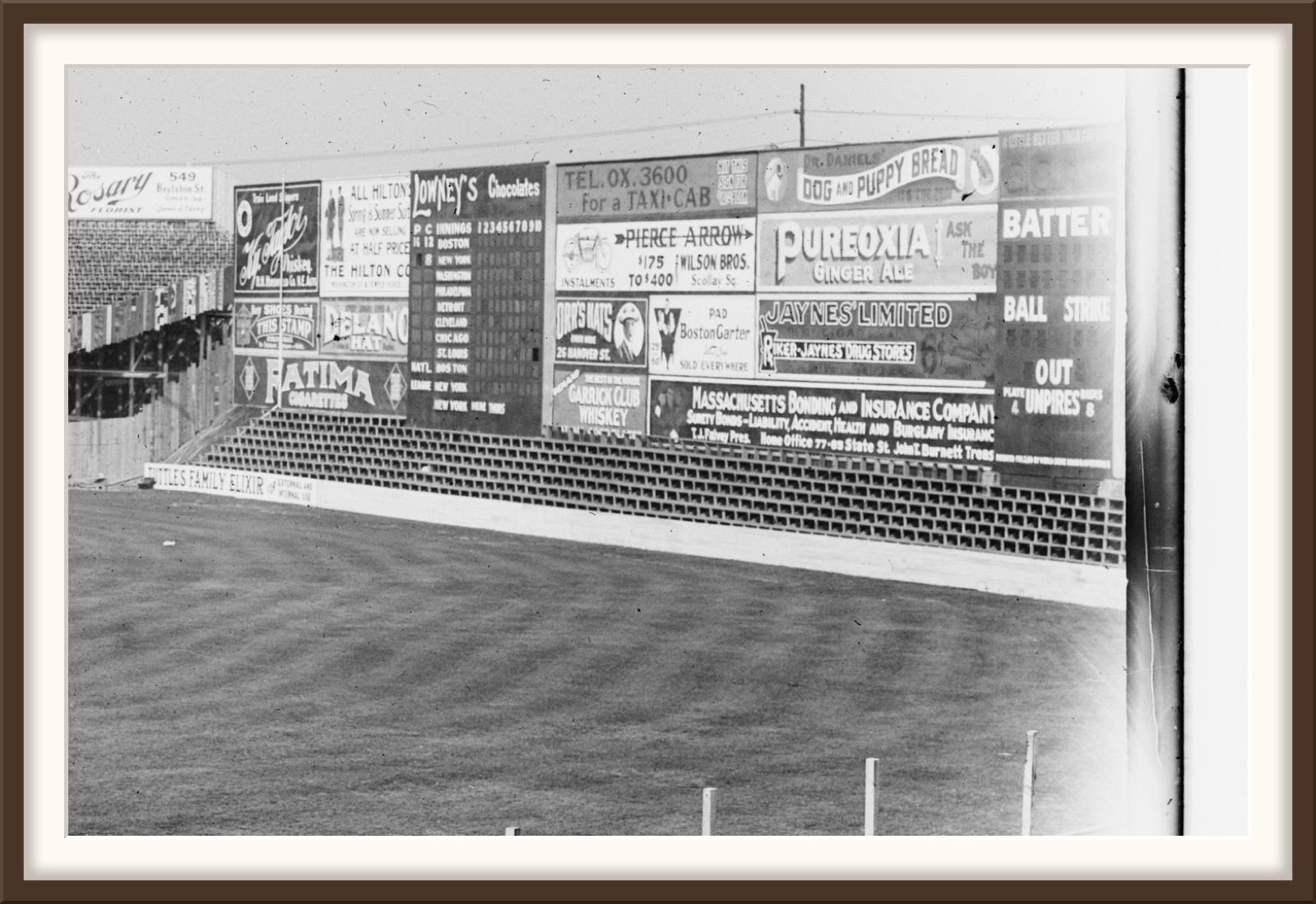
Look at the foot of the wall. The ground climbs. That is Duffy’s Cliff, a ten-foot earthen bank from the left field foul pole to center, named for Red Sox left fielder Duffy Lewis, who learned to play it running uphill. On sold-out days fans sat on it.
Other parks had slopes. Crosley Field’s terrace in Cincinnati was the one I knew best. But one look at Duffy’s Cliff tells you why it was called a cliff: 45 degrees or more. Fielding a ball on it was an adventure.
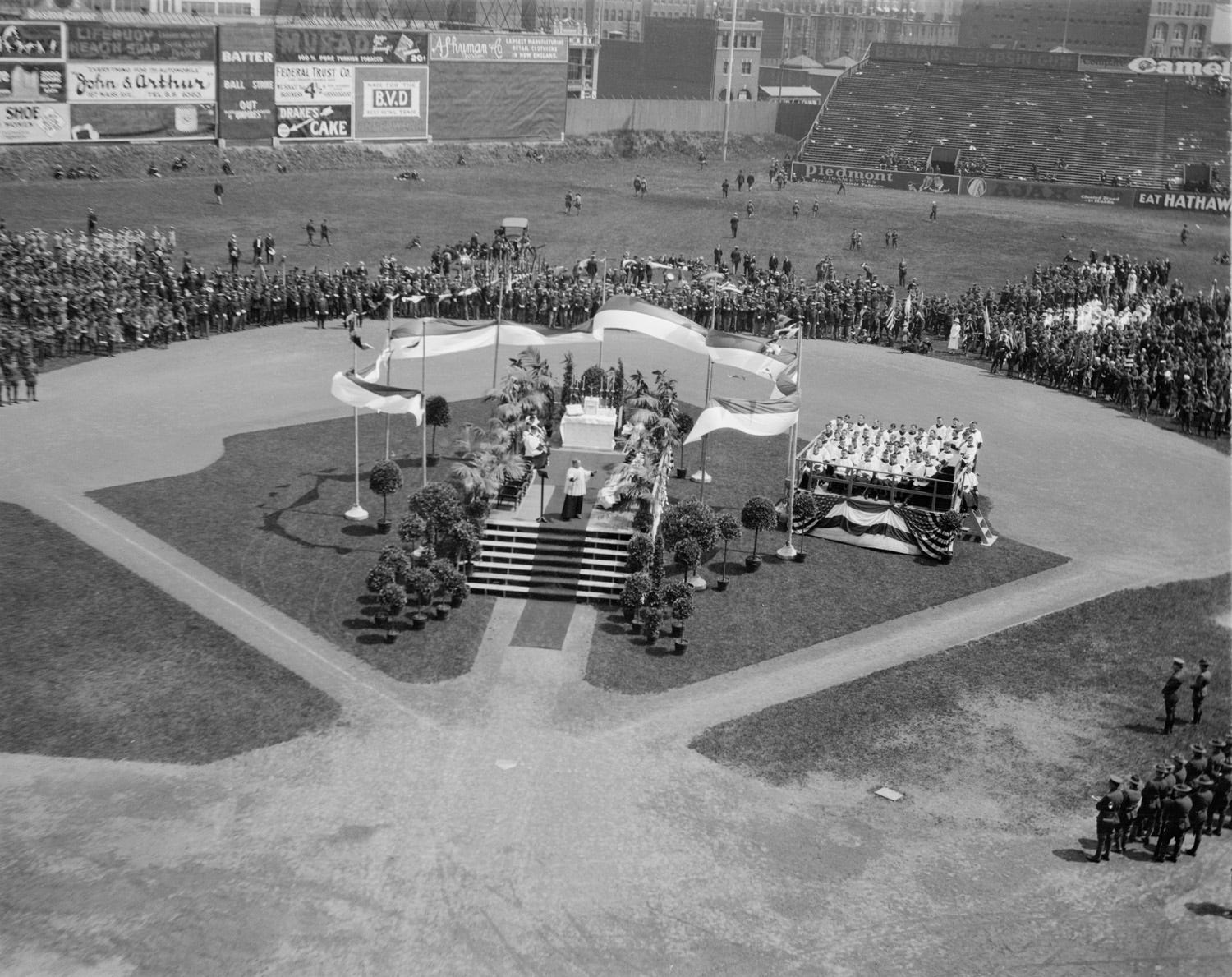
Leslie Jones of the Boston Herald caught the cliff on May 26, 1918, when 35,000 people filled the park for an open-air memorial Mass during the war. Look past the altar to left field: the bank is rough and unmown, and people are sitting on it.
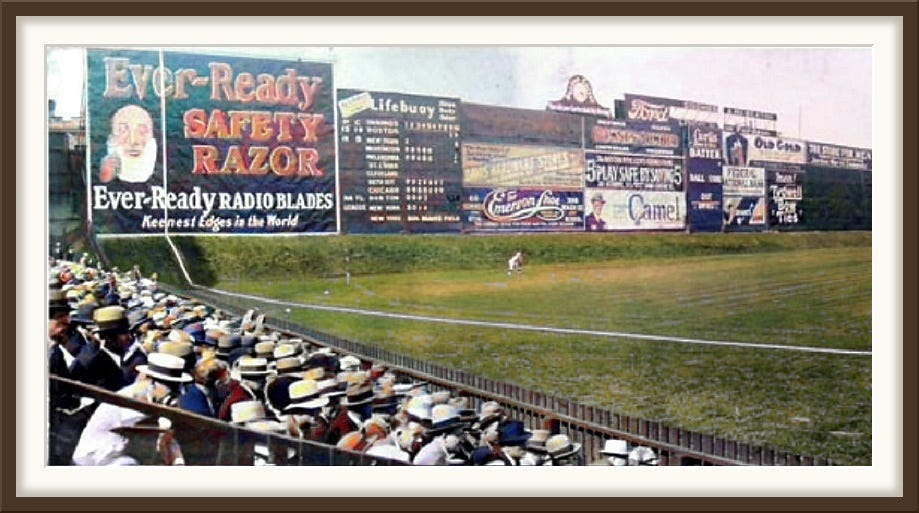
In 1929 the cliff was still there, and the wall was a busier billboard: Ever-Ready razors (which had just merged with Gem and Star to become Gillette’s big rival), Lifebuoy soap over the scoreboard, Ford, Camel, Old Gold, and the Federal National Bank, which the bank runs of December 1931 closed for good.
Fire, and a new wall
Fenway burned on January 5, 1934, early in Tom Yawkey’s rebuilding. Out came the park we know: concrete stands, a new left field wall, and the cliff leveled flat.
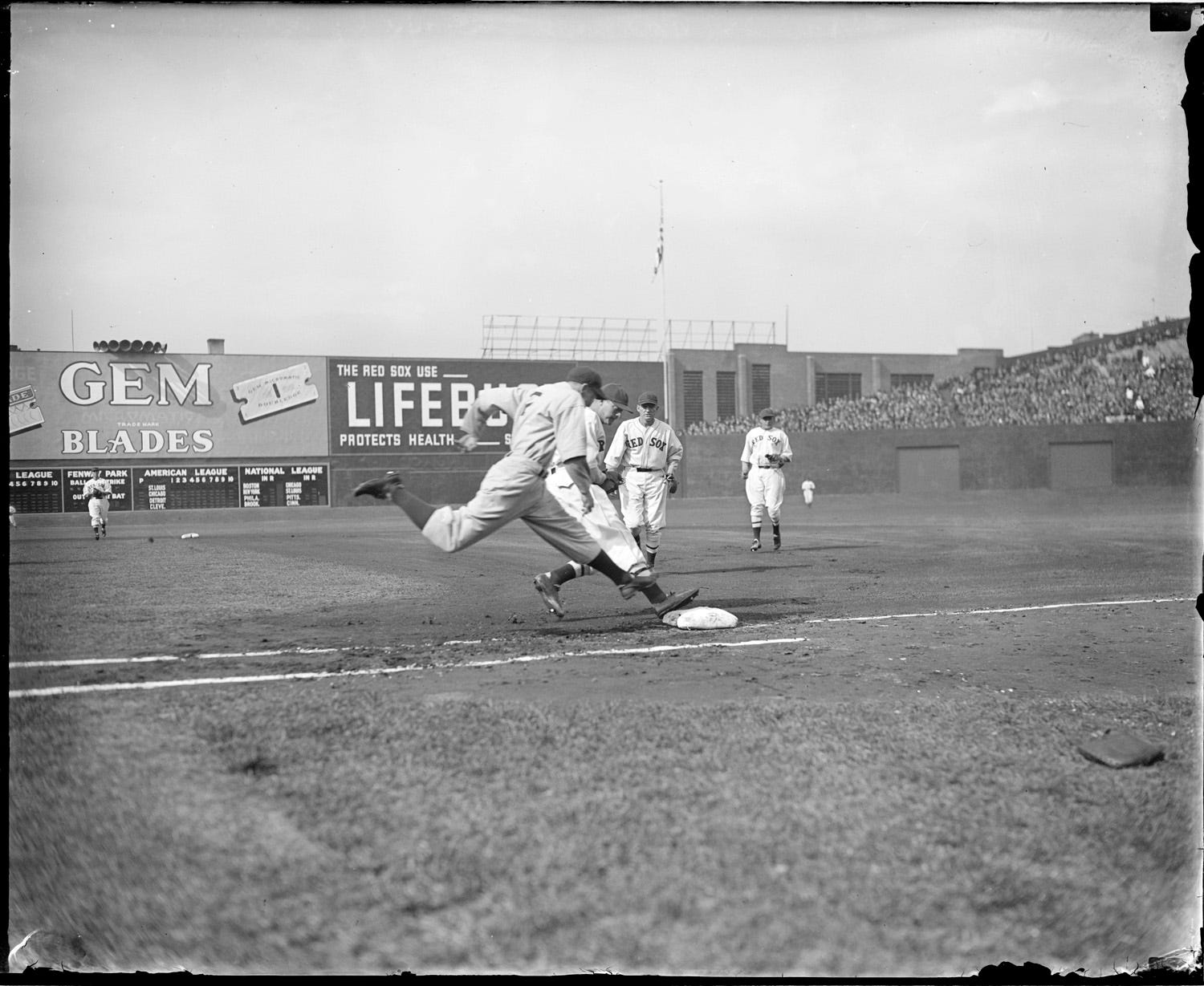
Jones caught the new wall that April behind a close play at first, painted with ads end to end. It was the Green Monster, thirteen years before anyone painted it green.
The whole way round
In 1947 the ads came off and the wall went green.
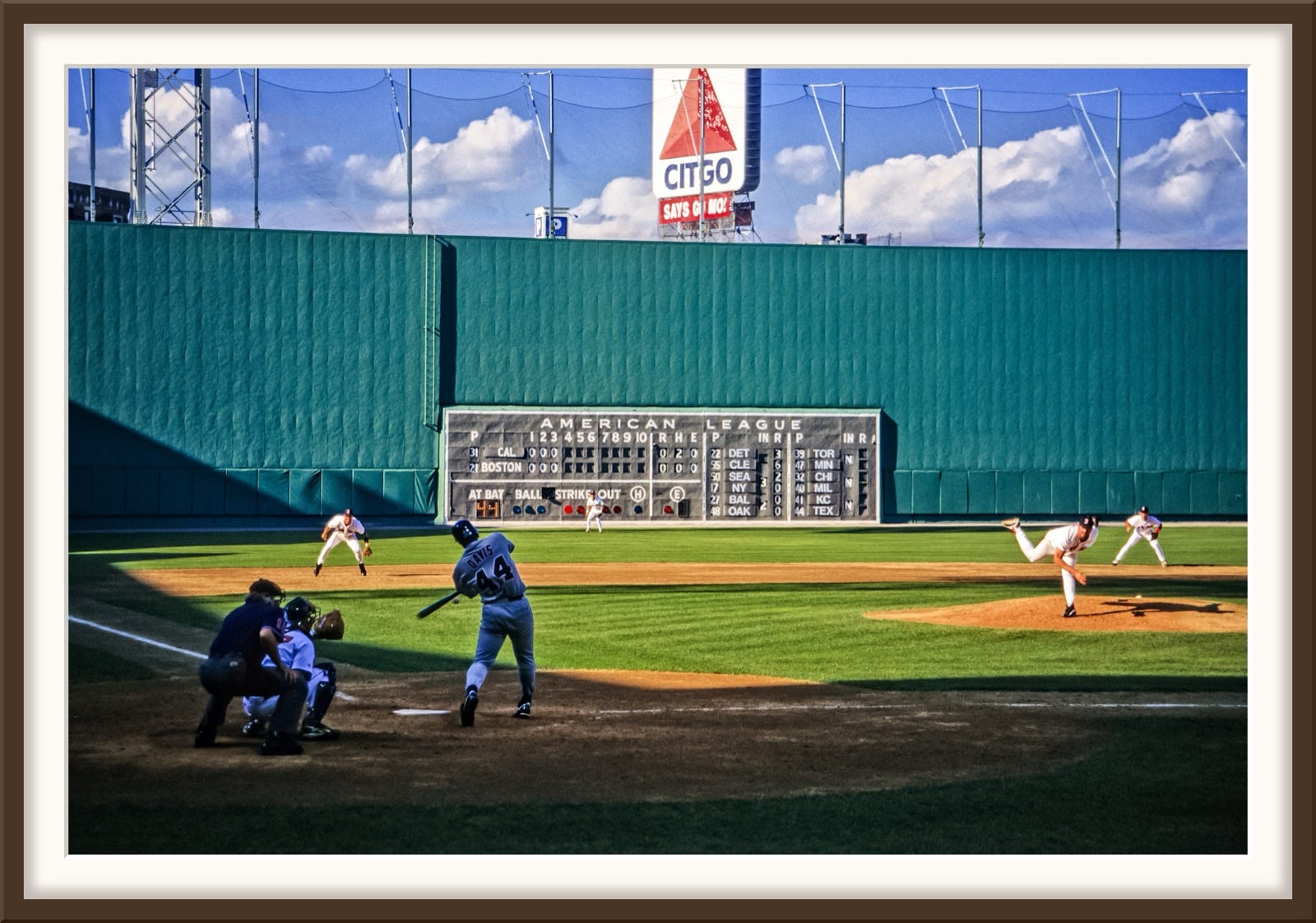
I love this picture: nothing but green wall, with the Citgo sign popping up behind it. The sign is an official Boston landmark now, voted in by the city in 2018.
It did not last. Coca-Cola bottles went up in 1997, seats replaced the net in 2003, and the ads came back. In 1912 it was a billboard. Today it is a billboard again.
Play the second jigsaw, Fenway today
More baseball, and more maps


A word of thanks
To Bob Cullum and the Jones family, for letting me use three of Leslie Jones's photographs, and to the Boston Public Library, which looks after them.
P.S. Coincidentally, right after I started this post, I found a book by Ted Williams’s daughter in the bookshed, and then ran into someone who has an autographed, inscribed photograph of Ted. All pretty cool. I haven’t gotten to the part about his head being frozen.
Thanks for your support, as always,
Cameron Cross
Full-resolution images
The 1912 left field wall, colorized, full resolution

Bromley atlas plate 33, 1908, full resolution

Bromley atlas plate 33, 1912, full resolution

Sources
The Boston Globe, “35,000 at Open-Air Memorial Mass,” May 27, 1918, page 1
Boston Red Sox, Fenway Park Living Museum timeline, 1912 to 1919 (memorial Mass, May 26, 1918)
Duffy’s Cliff in profile, photographer unknown, about 1929, as posted by Old Time Baseball Photos
Jerry Reuss, “Fenway Park 1996”, Wikimedia Commons, CC BY-SA 2.0

Hektoen International, “Tuttle’s Family Elixir”