

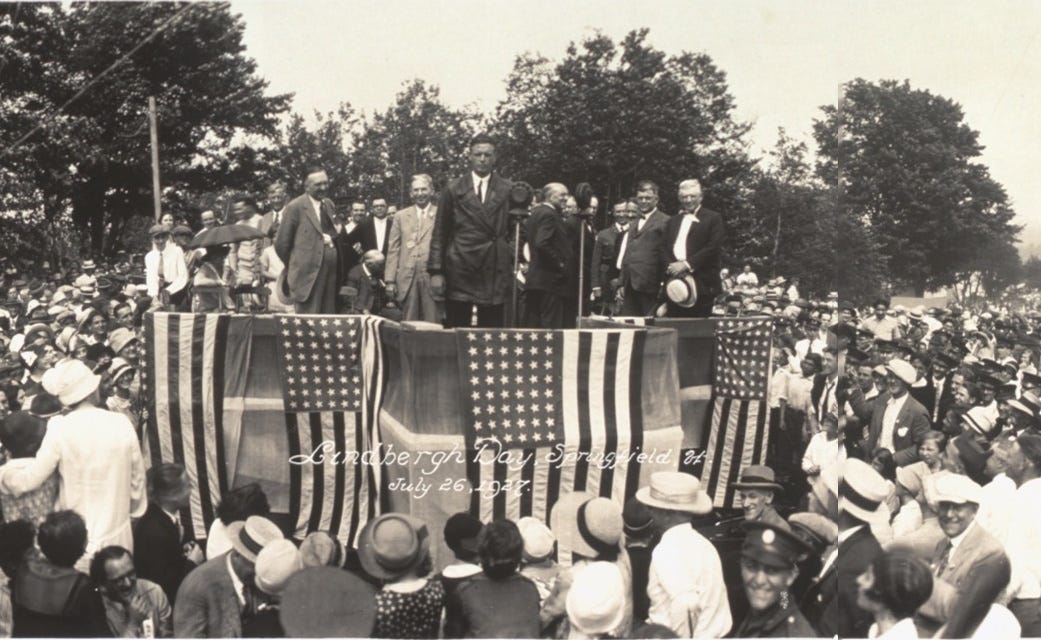
This week’s jigsaw: puzzles.curioustorian.com/lindbergh-springfield-1927
On Tuesday, July 26, 1927, Charles Lindbergh landed the Spirit of St. Louis at Springfield, Vermont. He had crossed the Atlantic two months earlier and was, at that moment, the most famous person alive. More than twenty thousand people came out to a hayfield to see him, in a state of about 357,000.
He came to Springfield because it had the only real airfield in the state, and it had that because of one man: James Hartness, machine-tool magnate, amateur astronomer, and former governor, who built it and, there being no hotel grand enough, took Lindbergh home to sleep at his own house.
He came to Springfield for the only real airfield in Vermont, built by former governor James Hartness, machine-tool magnate, amateur astronomer and a true Vermont luminary.
Hartness took Lindbergh home to sleep at his own house, a wonder in itself and still an inn today.
The reason you can see the whole crowd at once is that the photographer brought a Cirkut camera, the rotating machine I wrote about this spring. A. H. Bigelow came up from Brattleboro with one because it was the only camera that could hold Lindbergh and the twenty thousand who came for him in a single frame.
Here is the whole field he caught, with this week’s puzzle, the speaking stand, marked inside it.

Want to get lost in it? Open the whole panorama full size and zoom right in, twenty thousand faces, hat brims, and Model Ts, in fine detail. (Or the untouched original, Cirkut seams and all.)
Thanks for your support, as always,
Cameron Cross


How this week’s rabbit hole went
This one started with our almanac quietly flagging that July 26 had something timely relevant to The Curioustorian. Then it grew, the way these always grow, and then it came back down to the one picture above. In case you like the long way round, here is the trail:
The almanac hit. A date, a place, and a promising line: “Lindbergh Day, Springfield.” That was the whole of it to begin with.
The man who built the field. James Hartness turned out to be the real story: a lathe titan who gave Vermont its first airport, and whose home telescope grew into Stellafane, the birthplace of amateur telescope making in America. That is a whole post of its own, coming soon.
The tour. Springfield was one of 82 stops in 1927. Lindbergh gave nearly the same speech in every town and dropped a printed, identical thank-you note from the air on the ones he skipped, telling each place it was specially suited to aviation. He was, in the nicest way, selling airports.
The flight itself. On the way in he passed low over Rutland and dropped that note (a local doctor caught it, the Rotary Club framed it), and the Spirit of St. Louis flew right over Hanover and Lebanon on its way to the field.
And back to the picture. Twenty thousand people, one afternoon, one machine wide enough to keep them all. Which is where the puzzle came from.
One last thought. When Lindbergh told Springfield that aviation would remake Vermont, he was making a promise the region had heard before. Three generations earlier the railroad had come through and done exactly that, turning river towns into hubs and putting the map itself up for grabs. See the railroad routes of 1854, Union Station, and the Westboro rail yard. The airplane was simply the next machine to promise the same thing.
More on the camera:
what a Cirkut is · a gallery of panoramas · White River Junction, 1915
Sources:
Photograph: “Lindbergh Day, Springfield, Vt., July 26, 1927,” A. H. Bigelow, Brattleboro, Vt. Library of Congress, Panoramic Photographs collection (https://www.loc.gov/item/2007663405/). No known restrictions on publication.
Crowd figure, date, and route: The Landmark, White River Junction, Vt., July 28, 1927; The Rutland Daily Herald, July 27, 1927; the Log of the Spirit of St. Louis.
Vermont population: 1930 United States Census, Vermont (https://vermonthistory.org/client_media/files/Learn/Census%20Records/1930-Census.pdf).
Hartness and Stellafane: Stellafane / Springfield Telescope Makers (https://stellafane.org)
James Hartness, American Precision Museum (https://americanprecision.org/profile/james-hartness/).